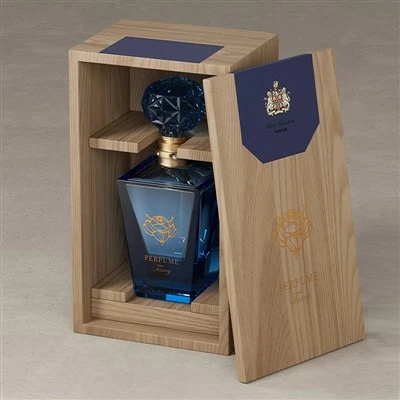
I. Material Introduction: The Lightest Commercial Hardwood, Packed with Wisdom
Paulownia (scientific name: Paulownia) is a fast‑growing broadleaf tree native to East Asia. It is known as "one of the lightest commercial woods in the world" – its air‑dry density is only 0.23–0.40 g/cm³, about 40% lighter than most common woods. This means that a standard‑sized paulownia gift box typically weighs only 60‑70% as much as a similar pine box.
But "light" does not mean "brittle." Paulownia has long fibres and a uniform structure, combining lightness with toughness. Its tangential shrinkage rate is only 4%–5.5%, far lower than pine's 6.5%–8.0%, making it resistant to deformation and cracking. In addition, paulownia naturally contains trace amounts of tung oil components, giving it certain antibacterial properties and moisture‑buffering capabilities. It releases no free formaldehyde and has no pungent odour.
In terms of sustainability, paulownia has a growth cycle of only 8–10 years and can regenerate naturally from the root after harvesting. With FSC‑certified sustainable forest sources, paulownia has become an important material choice for eco‑friendly packaging.
From a cost perspective, the raw material price of paulownia is approximately RMB 2,200/m³, far lower than pine at RMB 3,800/m³ and black walnut at RMB 12,000–18,000/m³. Coupled with its relatively soft texture, which makes it easy to process, the yield rate can reach 85% – these figures position paulownia as a highly competitive material option in the custom wooden box sector.
II. Performance in Wooden Boxes: Light, Stable, Smooth, and Pure
The performance of paulownia in wooden boxes can be summed up in four words: light, stable, smooth, and pure.
Light – Paulownia boxes feel extremely light in the hand, making them easy to carry and transport, especially suitable for gift packaging that needs to be mailed or carried personally. For cross‑border e‑commerce and gift‑mailing scenarios, paulownia boxes can significantly reduce logistics costs.
Stable – Paulownia responds gently to humidity changes, buffering against environmental fluctuations. In a 48‑hour accelerated aging test under high humidity (85% RH, 35°C), paulownia boxes showed only local warping of 0.2 mm, without affecting normal opening and closing. Its low thermal conductivity (0.12–0.15 W/m·K) effectively insulates against external temperature and humidity fluctuations, preventing tea oxidation and ink stick dampness. For this reason, paulownia is widely used in ancient zither soundboards, traditional Chinese medicine cabinets, Buddhist scripture cases, and scholarly storage vessels – its "insensitivity" to humidity changes is precisely the most delicate protection for its contents.
Smooth – After planing, paulownia exhibits a silky sheen, with fine, soft light‑beige grain that feels warm and skin‑like after sanding. It presents a natural matte finish without the need for lamination. It is especially suitable for drawer‑type, lid‑and‑base, and other box structures that require frequent opening and closing and direct hand contact – sliding smoothly without sticking, and becoming even more polished with use.
Pure – Paulownia has a subtle, elegant wood fragrance that is not pungent and does not impart off‑flavours. Its natural micro‑porous structure is breathable yet moisture‑resistant, preventing mould while avoiding stuffiness for the contents. For items sensitive to odour and humidity – such as tea, ink sticks, calligraphy and painting materials, and spices – paulownia boxes are among the few natural vessels that can stably preserve authenticity over the long term.
III. Surface Finishing Techniques: Maximising Strengths, Minimising Weaknesses
Paulownia has a relatively soft texture (end‑face hardness approx. 1,600 N), which presents both opportunities and challenges in surface finishing. Choosing the right technique can leverage its strengths and compensate for its weaknesses, fully realising the wood's natural advantages.
(1) Transparent Coatings: Preserving Authenticity with Protection
The most attractive feature of paulownia is its natural colour and grain. Clear varnish, matte varnish, and wood wax oil are the mainstream choices for preserving its authenticity:
Clear varnish / matte varnish – Retains paulownia's natural colour and presents a matte or subtle sheen, ideal for "natural wood style" tea boxes and scholarly boxes. It is recommended to use a "primer + two‑component polyurethane topcoat" process, ensuring the film hardness reaches at least 2H and the thickness is no less than 0.3 mm, to enhance surface impact resistance.
Wood wax oil – Wood wax oil has excellent penetrating properties and can deeply infiltrate paulownia fibres. However, due to the wood's low density and strong oil absorption, multiple coats are required to achieve the desired effect. Studies show that the improved wood wax oil process yields 5.41% higher brightness than traditional methods, better revealing paulownia's warm, smooth texture.
(2) Colouring and Antiquing: Transforming Character, Expanding Style
Paulownia's light‑coloured base provides a broad palette for colouring:
Wipe staining / dyeing – Using wipe‑stain or dye finishes can alter paulownia's natural colour to achieve walnut, mahogany, antique, or other tones, giving a high‑end wood visual effect at low cost.
Antiquing / distressing – Through localised sanding, staining, baking, and other techniques, a sense of age can be created. Light baking is a common treatment for paulownia boxes – it preserves the wood's natural texture while adding a touch of warm, vintage character.
(3) Veneering and Reinforcement: Compensating Shortcomings, Enhancing Performance
To address paulownia's relatively low hardness, surface reinforcement techniques can be applied:
Wood veneer – Applying a thin slice (approx. 0.5 mm) of precious wood to the paulownia substrate achieves the visual effect of high‑grade woods like black walnut or cherry at a highly cost‑effective price.
Digital spraying hardening process – An emerging technique in recent years, this uses special coating treatments to significantly improve surface hardness and abrasion resistance while retaining paulownia's natural feel.
(4) Surface Decoration: An Excellent Substrate for Engraving and Printing
Paulownia's uniform fibre structure makes it an ideal substrate for surface decoration:
Laser engraving – The smooth, consistent grain of paulownia allows for clean, precise engraving with sharp visual contrast, making it ideal for brand logos and custom patterns. Its edge‑chipping rate is 40% lower than that of pine.
Screen printing / hot stamping / branding – The fine surface of paulownia provides excellent ink adhesion and hot‑stamping results, suitable for multi‑colour printing and intricate patterns.
Conclusion
The value of paulownia in the custom wooden box sector is being rediscovered by more and more brands and designers. It is not the most expensive wood, but it is the material that best understands "proportion" – light without being flighty, stable without being stiff, smooth without being greasy, and pure without being dull. In today's gift‑packaging landscape, which demands both "lightweight" and "quality," paulownia stands as a natural bridge between cost and quality, function and aesthetics, leveraging its unique material endowments.